What Does EcoBoost Mean? A Plain-Language Guide for Ford Buyers
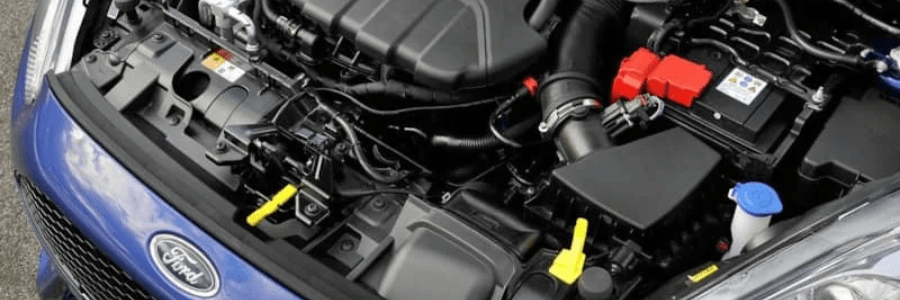
If you’ve spent any time shopping for a new Ford, you’ve probably seen the word EcoBoost® attached to an engine. You’ll find EcoBoost engines across the Ford lineup, from sporty cars and practical SUVs to hardworking trucks.
But what does EcoBoost actually mean? Is it a hybrid? Is it simply a smaller engine? And does choosing EcoBoost mean sacrificing power for better fuel efficiency?
The short answer: EcoBoost is Ford’s name for a family of turbocharged gasoline engines designed to deliver strong performance while getting more from a smaller engine. Ford describes the technology as providing turbocharged power with the fuel efficiency advantages of a smaller gas engine.
For drivers shopping at Miller Hughes Ford in Cornwall, ON, here’s what that means in plain English.
What Is a Ford EcoBoost Engine?
An EcoBoost engine is still a gasoline engine. It isn’t automatically a hybrid, and you don't need to plug it in.
The big difference is turbocharging.
A turbocharger forces additional air into the engine, allowing it to burn fuel more effectively and produce more power than you might expect from its displacement. Many Ford EcoBoost applications also use direct fuel injection, which precisely delivers fuel into the engine to help optimize combustion and performance.
In practical terms, Ford can use a relatively compact engine while still producing the horsepower and, particularly, the torque drivers expect.
Does EcoBoost Mean Better Fuel Economy?
The “Eco” part of the name can cause some confusion.
EcoBoost technology is designed to combine performance with efficiency, rather than simply making fuel economy the only priority. Ford describes EcoBoost as offering the power of turbocharging with the fuel efficiency of a smaller gasoline engine.
Your actual fuel consumption will still depend on the vehicle, engine, drivetrain, weather, traffic, driving habits, cargo, towing and other factors.
That distinction matters. An EcoBoost engine in a performance car is doing a very different job from one powering a pickup truck.
Are EcoBoost Engines Powerful?
They certainly can be.
Turbocharging helps EcoBoost engines produce substantial power and torque without necessarily requiring a larger-displacement engine.
Consider the current Ford Mustang. Its 2.3L EcoBoost engine produces 315 horsepower and 350 lb-ft of torque, proving that a four-cylinder engine doesn't necessarily mean modest performance.
EcoBoost technology also plays a major role in Ford trucks. The current F-150 offers multiple EcoBoost choices, including 2.7L and 3.5L V6 engines. The 3.5L EcoBoost delivers particularly strong torque and is available in configurations designed for substantial towing capability.
In other words, don't judge an engine solely by the number before the “L.”
Why Does Ford Use EcoBoost in Trucks?
This is where the technology makes a lot of sense.
Truck buyers need torque for acceleration, hauling and towing. Turbocharged engines can deliver strong low-end and mid-range torque while giving Ford another alternative to traditional larger-displacement engines.
For example, Ford's current F-150 trim lineup includes a 2.7L EcoBoost V6 producing 325 horsepower and 400 lb-ft of torque, while the available 3.5L EcoBoost V6 produces considerably more torque. Exact towing and payload ratings depend heavily on configuration, equipment and other factors.
For Cornwall-area drivers using an F-150 for work, towing a trailer, heading to the cottage, or simply wanting plenty of everyday passing power, an EcoBoost engine may be worth considering.
Is EcoBoost the Same as a Hybrid?
No.
An EcoBoost engine is a turbocharged gasoline engine. A hybrid combines a gasoline engine with electric power.
Ford does, however, offer powertrains that bring these technologies together. For example, the F-150's available PowerBoost® Full Hybrid V6 uses a gas engine and electric motor as part of a hybrid powertrain.
The names sound similar, so it's an understandable source of confusion:
EcoBoost = turbocharged gasoline engine.
PowerBoost = Ford full-hybrid truck powertrain.
Neither should be confused with a fully electric Ford, which operates without a gasoline engine.
Do EcoBoost Engines Require Premium Gas?
Not necessarily.
Fuel requirements can differ depending on the specific EcoBoost engine and vehicle. Some Ford performance figures are achieved using higher-octane fuel, while other applications are designed to operate on regular gasoline.
Rather than assuming all EcoBoost engines require the same fuel, check the Owner's Manual for the specific Ford you're considering. That's particularly important when comparing different models or performance variants.
Is an EcoBoost Engine Good for Ontario Driving?
For many drivers, the appeal is versatility.
Around Cornwall and Eastern Ontario, your vehicle may need to handle everything from short daily errands to Highway 401 commuting, winter driving, longer road trips and occasional towing.
EcoBoost engines are available across different Ford vehicle types precisely because the technology can be tuned for different purposes. A buyer interested in responsive everyday performance may have very different needs from someone shopping for an F-150 to tow regularly.
The important thing isn't simply deciding that “EcoBoost is better.” It's choosing the engine that suits how you actually drive.
EcoBoost vs. a Traditional Gas Engine: Which Should You Choose?
There's no single right engine for every Ford buyer.
An EcoBoost may appeal if you want strong torque and performance from a smaller turbocharged engine. A naturally aspirated gasoline engine may appeal to drivers who prefer that traditional engine design. Ford also offers hybrid, electric and diesel powertrains in portions of its broader lineup, giving buyers several ways to match a vehicle to their needs.
When comparing engines, consider your typical commute, annual kilometres, towing requirements, passenger and cargo needs, and the type of driving you do most often.
Find the Right Ford EcoBoost Vehicle at Miller Hughes Ford
You don't need to become an engine expert before buying your next Ford. You just need to understand what the terminology means and which powertrain makes sense for you.
At Miller Hughes Ford in Cornwall, Ontario, our team can help you compare available Ford F-150 truck trims and engines and explain the differences without burying you in technical jargon.
Whether you're considering an EcoBoost-powered Ford for your daily drive through Cornwall, regular trips across Eastern Ontario, or the capability you need from your next truck, experiencing the difference from behind the wheel is the best place to start.
Connect With Us


